

Triple Bunk Bed
Triple bunk beds are a great solution for those who have space at a premium. They can accommodate multiple sleepers efficiently. Quality bunk beds are long-lasting and can support the combined weight of three persons without compromising safety or stability.
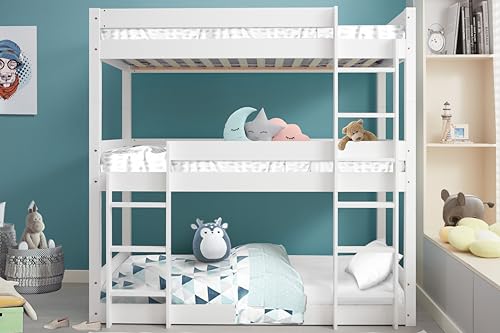
Maintaining your bunk bed by performing regular inspections will help to identify problems early and extend its life span. Proper cleaning and care helps keep away water damage or insect infestation, as well as other issues that could affect the structural integrity of the bed.
Benefits
Triple bunk beds are an excellent method to maximize space in a child's bedroom. Three beds stacked vertically make floor space more efficient and create an open, clutter-free environment. The stacking design also encourages tidying since personal belongings can be easily stored in the designated spaces with each bed, encouraging an awareness of responsibility and ownership over the space that is yours.
Another benefit of a 3 bunk bed is that it will provide more sleeping accommodations than other beds which makes it an ideal choice for households with multiple children or families that often host guests. Depending on the design of the triple bunk bed, you can choose models that include separate twin beds or full-sized beds in the lower level. Some models come with the option of a pull-out trundle bed which can be used as an additional bed by guests.
They can also be the perfect environment to bond and foster sibling relationships as they let siblings share a space while keeping their privacy. The close proximity of beds also encourages an atmosphere of friendship and encourages them to spend more time together reading, playing games or sharing secrets. This sharing ethos extends to other aspects of their lives, positively affecting the quality of their relationships as adults.
A triple bunk bed is a fantastic way to save space and improve the appearance of your house. A majority of them have a stunning wood finish that is a perfect match for the surrounding decor. Some even come with an integrated ladder that enhances the overall design of the bedroom. Some designs feature under-bed storage which can be used to store books, toys or bedding.
Whatever design you pick, it's crucial to think about safety when buying a bunk bed. To ensure stability, make sure that the model you pick has the required weight and is constructed from robust materials. Additionally, make sure the bunks have railings on both sides to prevent children from falling off. Also, make sure that the ladder is simple to climb and sturdy, so that your children can climb it safely.
Design
Created for children's rooms Triple bunk beds are an efficient solution for rooms with limited space. They are available in a wide range of sizes, ranging from twin XL up to queen, to accommodate children who are growing or guests. They can also be customised with additional features, such as shelves, desks or drawers for under-bed storage to make them more multi-functional. This makes them ideal for a variety of decor styles, from modern to traditional, and fits well in rooms with varying dimensions.
The most commonly used design for a 3 bunk bed is one full size on top and two twins on the bottom. This configuration maximizes floor space for storage and play while providing plenty of space for sleeping for three people. A stacked twin over twin design is a great option for siblings who share a bedroom. If you're seeking a space-saving solution, a corner triple bed is a great alternative. It lets you use underutilized room space and also allows easy access to the upper bunks using stairs or ladders.
A free-standing triple bed that has a staircase and ladder for the top bunk is also a popular option. This type of bunk beds is perfect for children's bedrooms with high ceilings. It provides plenty of head space, while still leaving room for nightstands, dressers, and other furniture. You can also customize this type of bunk bed with an incline to make it extra fun for children.
It is crucial to select an enduring and durable design for a stacked bunk bed that is able to withstand the rigors of daily use. A lot of manufacturers employ a mix of woods, metals, and plastics in their designs, and some even provide a warranty to ensure long-lasting durability. Metal brackets are used to attach beds to the wall. This helps to prevent from bending, and also ensures that the bed is stable and safety.
When building the frame of a triple bunk bed it is essential to take measurements and mark each leg of the bunk to ensure it is positioned on the mattress properly. If you are creating a stacked bunk that has the middle bed at a different height than the bottom bunk, make sure to cut each 2x2 to a length that will allow it to fit around the leg of the bottom bunk. You might need to cut a 2.5 inch square from the corner of each piece of plywood to allow them to fit around the legs.
Materials
A triple bunk bed can be a great solution to saving space in a shared kids' room. It is ideal for small families as it saves space and removes furniture. In addition, this type of bed is typically constructed from sturdy and durable materials, which means it can hold three kids without the safety or comfort.
A DIY triple bunk bed can be adapted to suit your space and style preferences. You can add visual interest by applying different paint colors and wood finishes. Lighting can also add to the ambiance of the room. For instance, you can put LED strip lights under the beds or put fairy lights on the headboards to create an enchanting appearance. Be sure to install the lighting in a secure place and keep it out of reach of your children.
To build your triple bunk bed, begin by cutting the 2x6 boards and plywood sheets to the required lengths. This requires the use of a tablesaw. After you have cut the boards, sand them to an even finish. Then, attach the frames using wood screws.
You will require two long sides and one short side to make the bottom bunk. Use a 71-inch-long piece for the long side and a 39-inch piece for the shorter side. The size of the 4x4 leg that will pass through these sections of the frame will be the difference in size.
Once you have the frame assembled, join the slats using pocket holes. Make sure bunk beds single and double www.bunkbedsstore.uk drill the screws into the ends of the slats so that they aren't visible from the bed's front. Don't forget to glue the slats prior installing them.
The final step is to install the ladders. For this, you will need 1x2 trims. Attach them by using pockets to the rails of the ladder and then brad nail them to the supports. Make sure you measure the distance between the bottom end of each ladder and the edge of the bunk at the bottom to ensure it's exactly the same as the measurement of the top railing.
Safety
If they are properly constructed and maintained Bunk beds that are well-constructed and maintained are extremely secure. The risk of a collapse can be mitigated by selecting a design that meets national safety standards, using robust, durable materials and checking that all fittings are tight prior to use. Bunk bed safety can be improved by adhering to safety rules, teaching children how to use the ladder safely and ensuring that the area surrounding the bunk bed is free of dangers such as books, toys and clothing.
It is important to choose a bunk bed that has mattress platforms rather than box springs. They are more secure and will be able to support each sleeper's weight without stressing the frame. Also, it's an excellent idea to examine the mattress foundations regularly for signs of wear and wear and tear. If you require a box spring for a bunk bed, it's a good idea use a low-profile foundation that sits beneath the bunk rails. This will lower the chance of head injuries and roll-off accidents.
Make sure that guardrails on both sides of the bunk are long enough to stop the possibility of entrapment. If the gap between the guardrail and the top of your mattress is too wide, you could be at risk of strangulation. On the side of guardrails closest to the wall, the gaps should be small enough that a child's head won't pass through.
Children should use only the ladder or stairs to climb onto their bunk bed and not jump onto or climb on other furniture. Ladders should be placed away from electrical outlets, light fittings and ceiling fans, as well as windows to avoid falling or tripping. It is a good idea to encourage youngsters to sleep in the lower bunks if they are younger than six years old and to avoid rough play around the bunks.
Only one person at a given time to sleep on the top bunk. If the top bunk is used for playing or other activities, it could result in serious injuries if someone falls down or hits their head.